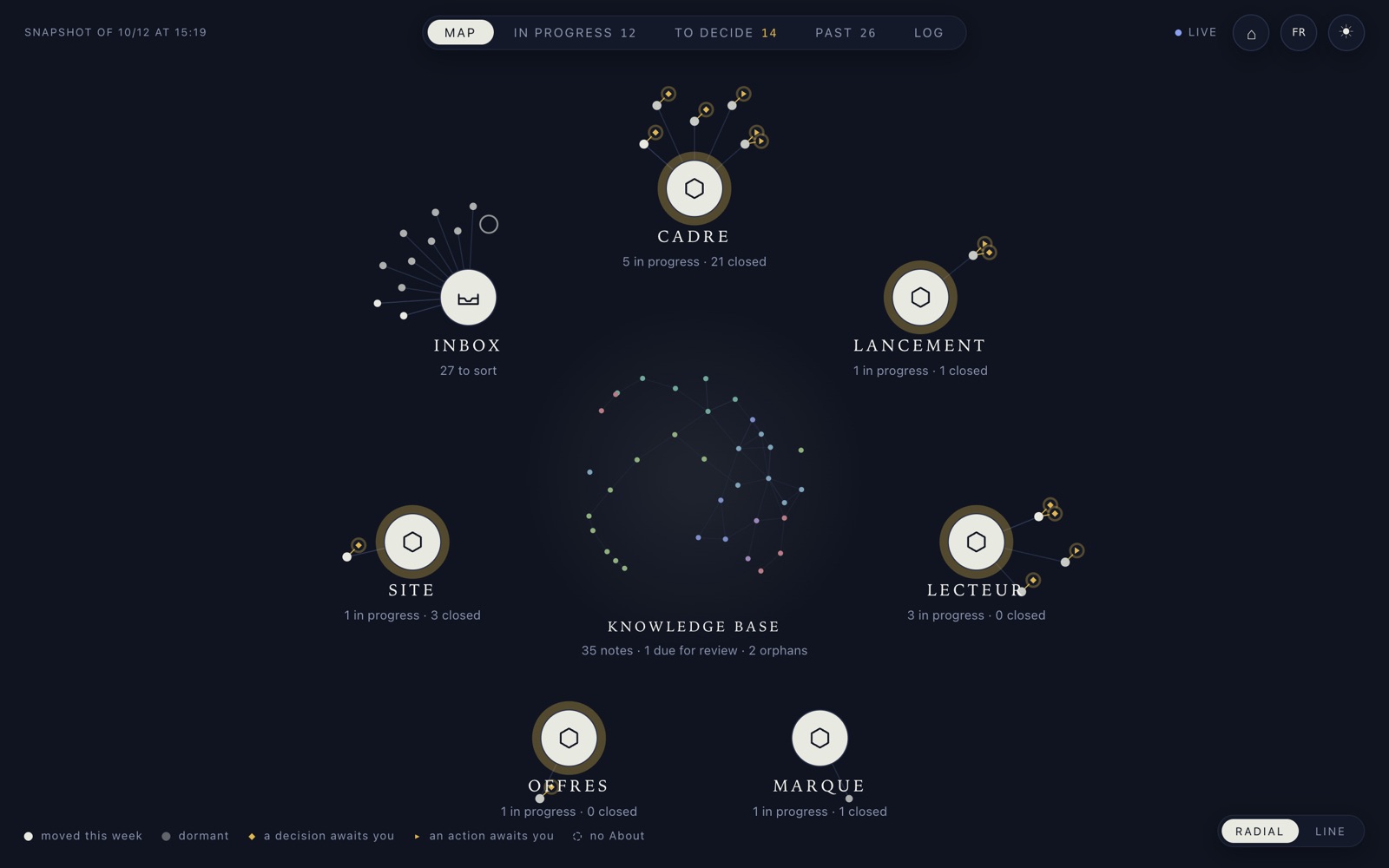
It's a work system that knows what to read, what to keep, what to fix
and what to forget.
Every exchange moves the project forward while keeping the system healthy:
decisions stay, knowledge stays current, mistakes become fixes.
The more you use it, the healthier it gets, and the more you can trust it.

It understands fast, produces fast, suggests well. Then the project runs long. Conversations stretch, numbers change, drafts start looking like decisions, corrected mistakes come back.
It's not that your AI forgets: it has a memory. It's that everything piles up and nothing gets put away. The longer it runs, the bigger the mess.
The problem is neither your prompt nor your model. It's that there is no system around them.
A workspace, and a discipline the AI holds on its own.
Your AI tends it like the encyclopedia of your business: one page per concept, in the open OKF format, all linked together.
Your AI has access to it, but the base is yours. You can read it, and edit it yourself.
A good answer becomes a knowledge page. A decision becomes a journal line, with its why. A flagged mistake becomes a fix, filed where it will serve.
You tidy nothing: the AI holds the discipline. The more you use it, the cleaner it gets.
# Project: Q2 lead analysis Problem Where do our web leads really come from? Sources CRM (HubSpot) · Analytics (Plausible) · website Decisions 2026-06-12 Exclude trade-show leads. Why: separate channel, would skew the web rate. 2026-06-14 “DIRECT” attribution ruled unreliable. Why: see adblock fix, journal of the 14th.
A lead analysis can pull your real data, not stale recollections.
Then the curve turns: every hour of work leaves the system healthier than it found it. Your AI always starts from what is true. Tidying up isn't an extra task: it's what the work produces on its own.
Proof of practice, not of adoption: the framework was built running them, and it runs them still.
The company behind the Jobaffinity ATS: strategy, CRM, lead pipeline, support, daily monitoring, all journaled.
Manence itself, and the site you are reading, built and run on Manence.
declic.media, 122 articles in three languages, a newsletter, editorial workflows. The first story signed with this method is online there: “AI is great… at first”.
One example, in full. One morning, a real lead lands in the CRM: “DIRECT, no source”. The system doesn't swallow it. It cross-checks the CRM against the site's analytics and reconstructs the true origin: Brave Search, around 11 am, the tracker was blocked by an adblocker. Then it measures: 39% of web leads had been mislabeled for weeks. The analysis was delivered. And the fix too, deployed the same day.
## [2026-06-14] fix | Web lead attribution Lead “DIRECT, no source”: CRM × analytics cross-check → true origin reconstructed: Brave Search, ~11 am (tracker blocked by an adblocker). Measured: 39% of web leads (28/71) mislabeled for weeks. Analysis delivered. Fix deployed the same day.
I never lose: I either win, or I learn something.
Two days of work. We wipe the whole session, open a blank one, and ask: “where were we?”
The AI knows everything. The project name, the state of every job, the decisions and their why. It loads exactly what it needs, nothing more. The conversation is gone; the system is intact.
This site is one example. It has its own job, like any project. Here is what a blank session answers when you ask where it stands.
> where are we on the site? Job site/refonte-manence-site (opened 06/07) Live home v5, since 08/07 Decisions 08/07 Slate theme by default, independent of the OS. 08/07 No two doors before the public release. Why: the repo was private. We don't show a door we cannot open. 10/07 The repo is public. The condition is lifted. So the waitlist goes, the two doors open.
The conversation vanishes. The system remains.
Those are the ingredients. The problem starts after: what holds true, what is only a draft, why option B was ruled out, and whether the figure in the CRM matches the analytics.
AI “memories” store everything that passes by, accumulation sold as progress. After a few weeks they serve the mix back. Manence keeps a place where what is written is true, and protects it from the rest.
A second brain is a wiki you hold. Company wikis have existed for twenty years; they are never up to date. In Manence the AI holds the discipline as a by-product of the work: you don't take a second job as the archivist.
Cowork gives it hands. Manence tells it what is true, what is in progress, and what is already settled. An MCP gives access; connected is not seen together: isolated tools can't see that an absurd number in the CRM is glaring next to the same client's books. And nothing in the raw agent structures the long run: no opening or closing of projects, no decision journal, no boundary between truth and draft.
And no, this isn't extra complexity: it's discipline where there was none, and the AI holds it, not you.
Everything is written in plain text, on your machine. Any AI can read it, Claude, GPT, a local model, and so can you, without AI. If you switch model, tool or interface, you lose nothing: the core of Manence depends on no surface.
Free. Open source. Models pass. Interfaces too. Your system remains.
Manence is open source: the code, the doctrine and the documentation live on GitHub, free. The community gave me a lot; this framework is my way of giving back.
The QUICKSTART sets up a complete project in one command, and walks you through the first three moves.
Read the QUICKSTART →The Manifesto is the framework's blueprint: the mental model, the seven layers, the nine laws. The why, in a single thread.
Read the Manifesto →A partnership, a collaboration, a business need? Write to me.
With an AI, it's great at first.
With Manence, that's only the beginning.